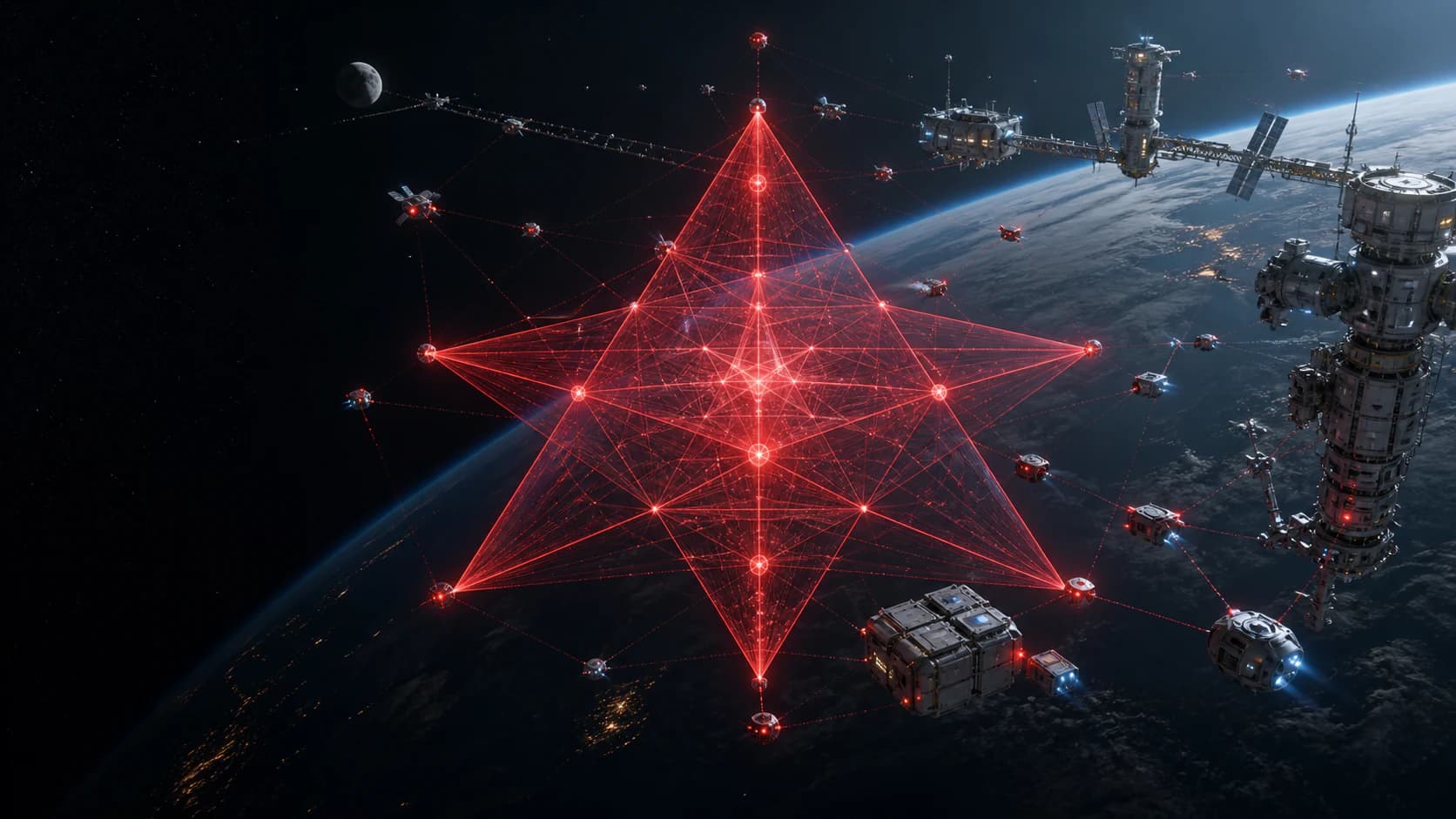
Military technology re-framed as protective infrastructure.
Each direction is a bounded research question. The goal is to increase continuity, awareness, recovery, and safety without developing an offensive capability.
Resilient logistics
Distributed mission logistics
Study networks that could reposition critical materials, replacement components, and emergency resources across remote or disrupted environments.
CONCEPT-STUDY OUTPUTContinuity architecture + scenario map
Orbital sensing
Space-domain awareness
Explore sensing and modeling concepts for detecting hazards, monitoring orbital infrastructure, and improving navigational safety without enabling targeting.
CONCEPT-STUDY OUTPUTHazard model + sensing concept
Mission assurance
Infrastructure resilience
Model how distributed fabrication, redundancy, and autonomous repair could help essential systems withstand disasters, accidents, and communications outages.
CONCEPT-STUDY OUTPUTResilience model + recovery sequence
Positioning
Protected navigation
Research dependable positioning and coordination systems for environments where conventional navigation is unavailable, degraded, or unsafe.
CONCEPT-STUDY OUTPUTNavigation architecture + failure study
Civil protection
Humanitarian response
Examine how rapid transport and distributed fabrication concepts could support evacuation, medical delivery, shelter construction, and disaster recovery.
CONCEPT-STUDY OUTPUTResponse concept + safeguards
Sustainment
Autonomous maintenance
Investigate bounded robotic systems that inspect, repair, and sustain remote infrastructure while remaining auditable, interruptible, and human-controlled.
CONCEPT-STUDY OUTPUTMaintenance concept + control boundary